

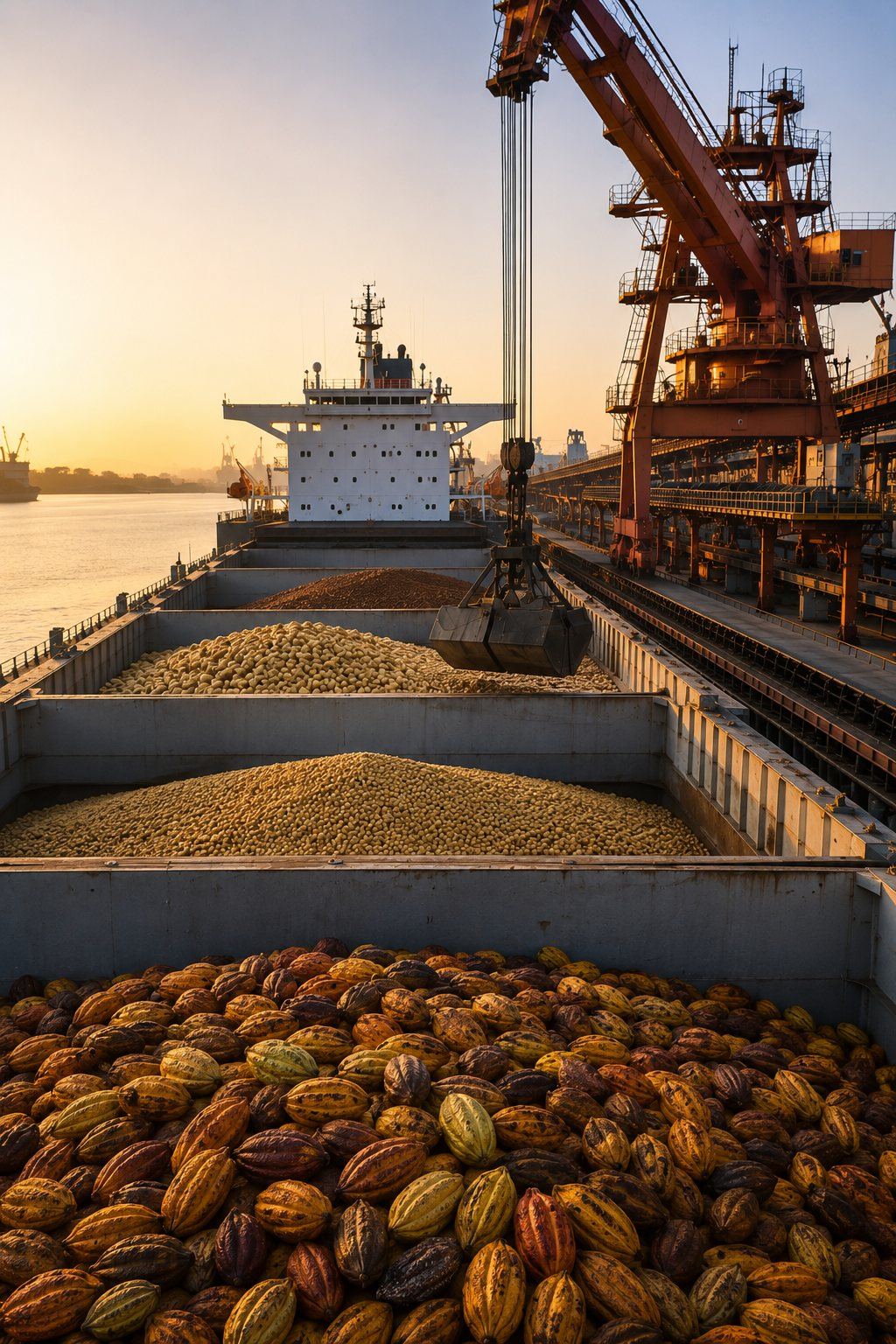
Where volume is moving across African agricultural corridors — and why settlement, not price, is often the real bottleneck.
The outlook for agro-commodity trade across Africa is frequently discussed in terms of price and harvest. But for the producers, processors and industrial buyers who actually move volume, the harder question is rarely "what is it worth?" It is "will this transaction complete cleanly?" Increasingly, the real bottleneck in agricultural commodity trade is not price discovery — it is settlement.
Volume, corridors and the shape of the trade
Agricultural commodity trade — grains and cereals, oilseeds, cash crops like cocoa, cashew and coffee — moves along established corridors that connect producing regions to processing and export points. The economics of any given transaction depend heavily on how dependably volume can move along those corridors and settle at the end of them.
When a corridor is reliable, producers can plan, processors can secure inputs, and industrial buyers can commit. When it is not, everyone builds in cost and caution. That reliability — of movement, fulfilment and settlement — is what shapes where volume actually flows, often more than headline price does.
Why settlement is the real bottleneck
At agricultural volumes, the risk concentrates at two points: the physical movement of goods and the settlement of the transaction. A price can be agreed quickly. What slows or breaks agro-commodity trade is the gap between delivery and clean payment — especially across borders, where currency and counterparty risk compound.
For a producer, a transaction that delivers but does not settle cleanly is worse than no transaction at all. For an industrial buyer, the reverse risk applies: paying into a trade that does not fulfil. Both sides are managing the same underlying problem — the absence of an accountable structure around the transaction.
Structuring the trade around fulfilment and settlement
This is why the most useful development in agro-commodity trade is structural rather than speculative. Coordinating logistics and settlement around verified physical trade — so high-volume flows move and settle dependably — addresses the actual bottleneck. It connects producers, processors and industrial buyers through infrastructure built for the reality of high-volume physical trade, rather than leaving each transaction as a bespoke, fragile arrangement.
That is the logic behind how Matta approaches commodity and agro-commodity trade: connect credible demand and supply, then coordinate the sourcing, logistics, fulfilment, finance and settlement around each physical transaction.
What to watch
For anyone trading agricultural commodities in the region, the indicators that matter most are corridor reliability and settlement friction — not just the price board. Where those two improve, volume follows. Where they do not, even attractive prices leave trade stranded.
The agro-commodity opportunity across Africa is real and large. Realising it depends less on predicting price than on making the trade itself dependable, from corridor to settlement.