

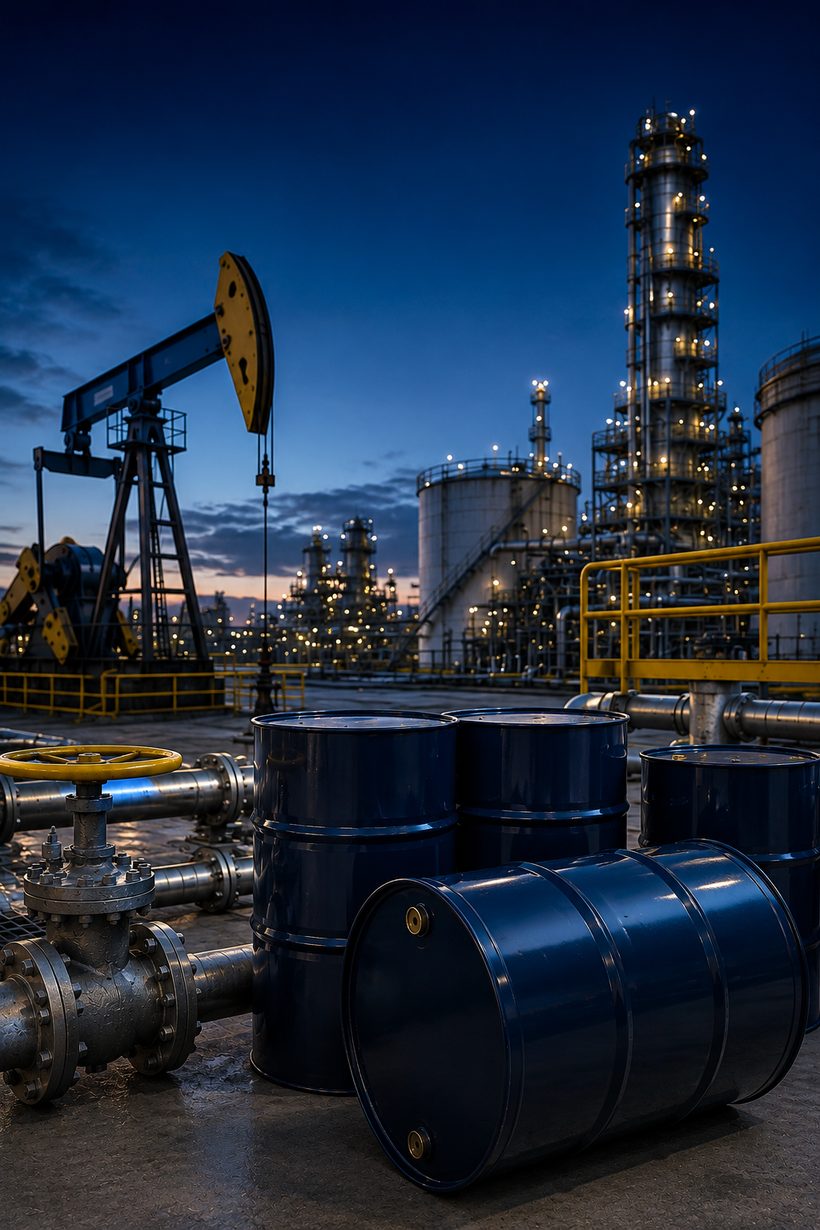
Downstream demand signals are shifting across emerging industrial economies. A look at the indicators that actually predict industrial input pricing.
The oil and gas cycle shapes the cost of a surprising share of industrial inputs — from process chemicals to production materials — across emerging industrial economies. But reading that cycle usefully means looking past the headline crude price to the downstream demand signals that actually predict what manufacturers will pay. For industrial buyers, the cycle is not an abstraction; it is an input-cost forecast.
Why the oil and gas cycle matters beyond fuel
Oil and gas are not only energy. They are feedstock and reference points for a wide range of industrial inputs and process chemicals. When the cycle moves, it moves the cost base of manufacturing well beyond the fuel bill. For any operation that consumes petrochemical-derived inputs, the cycle is a direct driver of input pricing — which is why industrial buyers, not just energy traders, need to read it.
The signals that actually predict input pricing
Downstream demand, not just crude price. The headline crude price is a lagging and noisy indicator for industrial buyers. Downstream demand signals — how much refined and derived product is actually being consumed by industry — are more predictive of where input prices are heading.
Supply reliability and logistics. In emerging industrial economies, the reliability of supply and the cost of moving it often matter as much as the underlying price. A disruption in logistics can raise the effective cost of an input even when the commodity price is flat.
Policy and currency. As with other industrial inputs, tariffs, import rules and currency movement can override the commodity signal entirely in determining landed cost.
Reading the cycle as an industrial buyer
The practical discipline is to stop treating the crude price as the forecast and start treating downstream demand, supply reliability and landed cost as the real indicators. A buyer who tracks those is far less likely to be surprised by an input-cost swing than one watching the oil price alone.
The oil and gas sector also depends on a reliable flow of its own industrial inputs — chemicals, raw materials and production inputs — where dependable supply and logistics matter as much as price. That two-way relationship, between the cycle and the inputs the sector itself consumes, is part of why oil and gas operations increasingly source through coordinated infrastructure rather than fragmented channels.
What to watch
For industrial buyers exposed to the cycle, the indicators worth monitoring are downstream demand trends, the reliability and cost of supply on the corridors you depend on, and the policy and currency environment in your buying market. Together, those predict input pricing far better than the crude price on its own.
The cycle will keep turning. The buyers who read the right signals will keep planning through it — while those watching only the headline price keep being surprised.